Glossary:
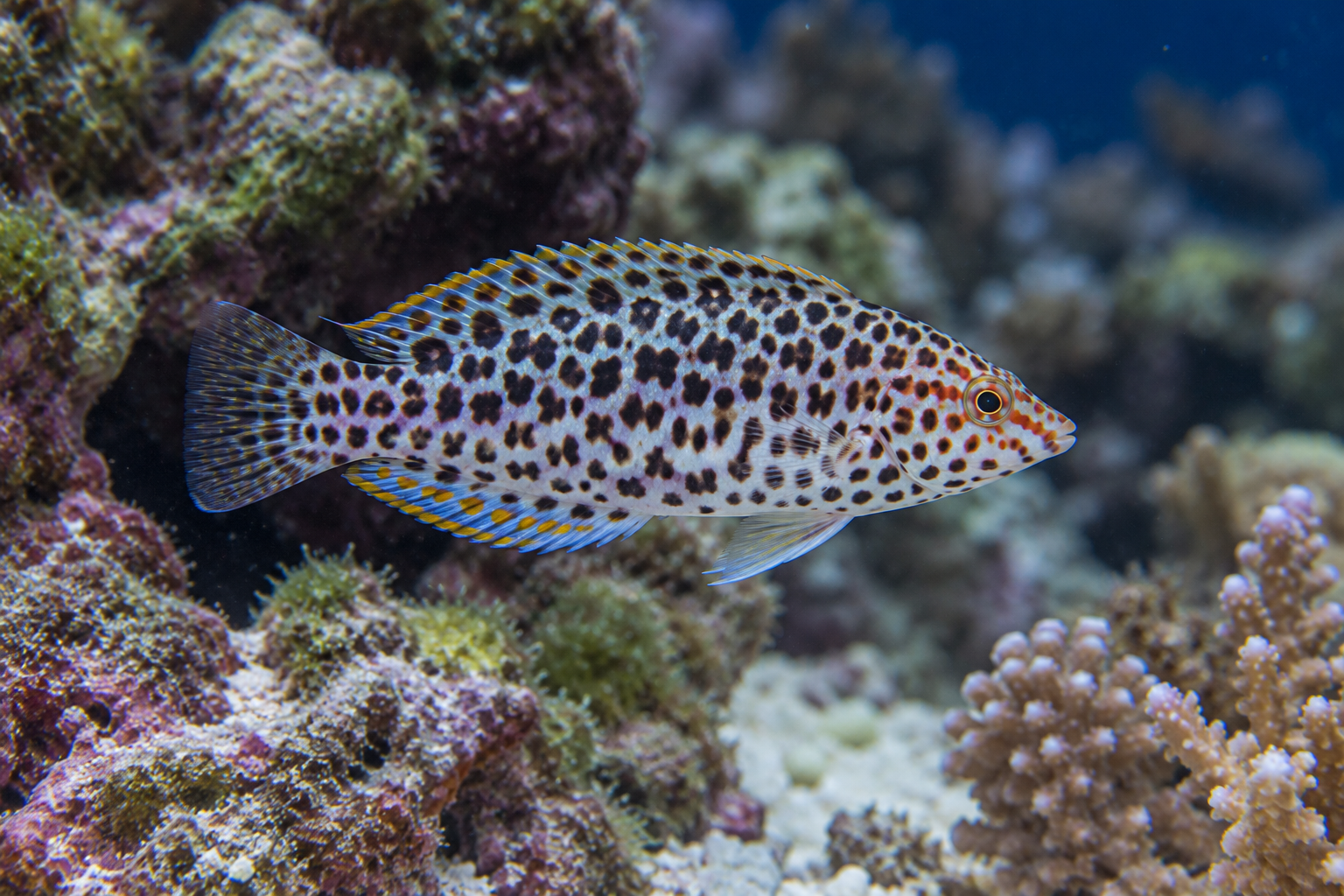
The Leopard Wrasse (Macropharyngodon meleagris) is a delicate, highly patterned reef fish known for its spotted body, curious foraging behavior, and graceful movement through live rock. Females and juveniles are usually covered in dark spots against a pale background, while mature males may develop stronger green, blue, and orange coloration. This changing appearance is part of what makes Leopard Wrasses especially appealing to experienced reef aquarists.
Native to the Indo-Pacific, Leopard Wrasses spend much of their day searching the sand and rockwork for tiny crustaceans and other small prey. They are peaceful, reef compatible, and visually striking, but they are not usually recommended for beginners. Newly imported Leopard Wrasses can be sensitive to shipping, may refuse food at first, and often require a mature aquarium with abundant microfauna before they can settle in successfully.
Leopard Wrasses are generally considered reef safe with caution. They do not typically nip at coral tissue, damage clam mantles, or disturb established coral colonies. Their natural behavior focuses on hunting tiny organisms around the sand bed and live rock rather than grazing on coral.
However, they are not completely safe with every invertebrate. Leopard Wrasses may eat copepods, amphipods, tiny ornamental shrimp, small crabs, feather dusters, and other small animals they can catch. They are best considered coral-safe, but not always completely cleanup-crew-safe. A mature reef tank with a healthy pod population is especially valuable because it gives the wrasse natural food sources while it adjusts to prepared foods.
Leopard Wrasses are carnivores that naturally feed on copepods, amphipods, tiny crustaceans, worms, and other small invertebrates. In captivity, they may be reluctant to eat at first, especially after shipping. A mature reef aquarium with an established population of pods can help support a new arrival while it learns to accept prepared foods. Offer a varied diet of frozen mysis shrimp, enriched brine shrimp, copepods, finely chopped clam, shrimp, squid, scallop, and high-quality marine carnivore pellets. Smaller meals two or three times per day are often better than one large feeding. Even after settling in, prepared foods should remain the foundation of the diet rather than relying only on the tank’s natural pod population.
Leopard Wrasses usually grow to around 5 to 6 inches long. Their size is manageable, but their active foraging behavior and need for mature live rock make them more demanding than many other fish of similar length.
A 75-gallon aquarium is a practical minimum for one Leopard Wrasse, though a 90-gallon or larger tank offers greater stability and more room for compatible reef fish. The tank should include a fine sand bed at least 2 to 3 inches deep so the wrasse can bury itself safely.
Keeping one Leopard Wrasse is the simplest option for most home reef aquariums. Multiple females may sometimes coexist in a larger, mature aquarium, and one male with several females can work in a carefully planned system.
A group should be introduced into a large tank at the same time, with abundant sand, live rock, and food sources. Keeping multiple males or adding a new Leopard Wrasse to an established individual’s territory can lead to stress or aggression.
With stable water quality, regular feeding, a mature reef environment, and peaceful tank mates, Leopard Wrasses can often live around 5 to 8 years in captivity. Some may live longer when kept in an established aquarium with consistent long-term care.
Their greatest challenge is the acclimation period. Poor nutrition, an immature tank, aggression from tank mates, and stress during shipping can significantly shorten their lifespan. Giving the fish time to settle without disturbance is important.
Leopard Wrasses are generally peaceful toward unrelated fish. They are more likely to retreat into the sand than start a fight, which makes them well-suited for calm community reef aquariums.
They may become territorial toward other Leopard Wrasses, closely related Macropharyngodon species, or similarly shaped wrasses competing for the same food. In a spacious aquarium with peaceful companions, their behavior is usually gentle and easygoing.
Leopard Wrasses are often more expensive than common beginner wrasses because of their specialized care needs, shipping sensitivity, and strong demand among reef aquarists. Prices can vary based on size, sex, coloration, collection location, availability, and whether the fish has already been quarantined or conditioned to eat prepared foods.
Females and juveniles are usually easier to find than mature males, while colorful male specimens may command a higher price. When choosing a Leopard Wrasse, look for one that is alert, swimming upright, actively picking through the substrate, and showing interest in food. Avoid thin fish, individuals with damaged fins, cloudy eyes, heavy breathing, or signs of stress from shipping.
Leopard Wrasses are peaceful fish that do best with calm tank mates that will not outcompete them during feeding or repeatedly disturb the sand bed. They are often comfortable in a mixed reef aquarium once established, but aggressive fish can make them hide constantly or prevent them from getting enough food.
Potential tank mates include:
Avoid Six Line Wrasses, aggressive dottybacks, triggerfish, lionfish, eels, large predatory wrasses, hawkfish, and highly territorial fish. Other Leopard Wrasses can also be challenging unless the aquarium is large enough to support a properly planned group.
Leopard Wrasses are available through specialty saltwater livestock retailers and local aquarium stores. Before purchasing one, make sure your aquarium is mature, has a fine sand bed, and contains enough natural microfauna to support a sensitive new arrival.
Where to buy Leopard Wrasse:
The Leopard Wrasse is a rewarding fish for aquarists with a mature, stable reef aquarium and the patience to meet its specialized feeding needs. With soft sand, abundant live rock, peaceful tank mates, and consistent nutrition, this beautiful wrasse can become one of the most active and distinctive residents in a reef tank.