Glossary:
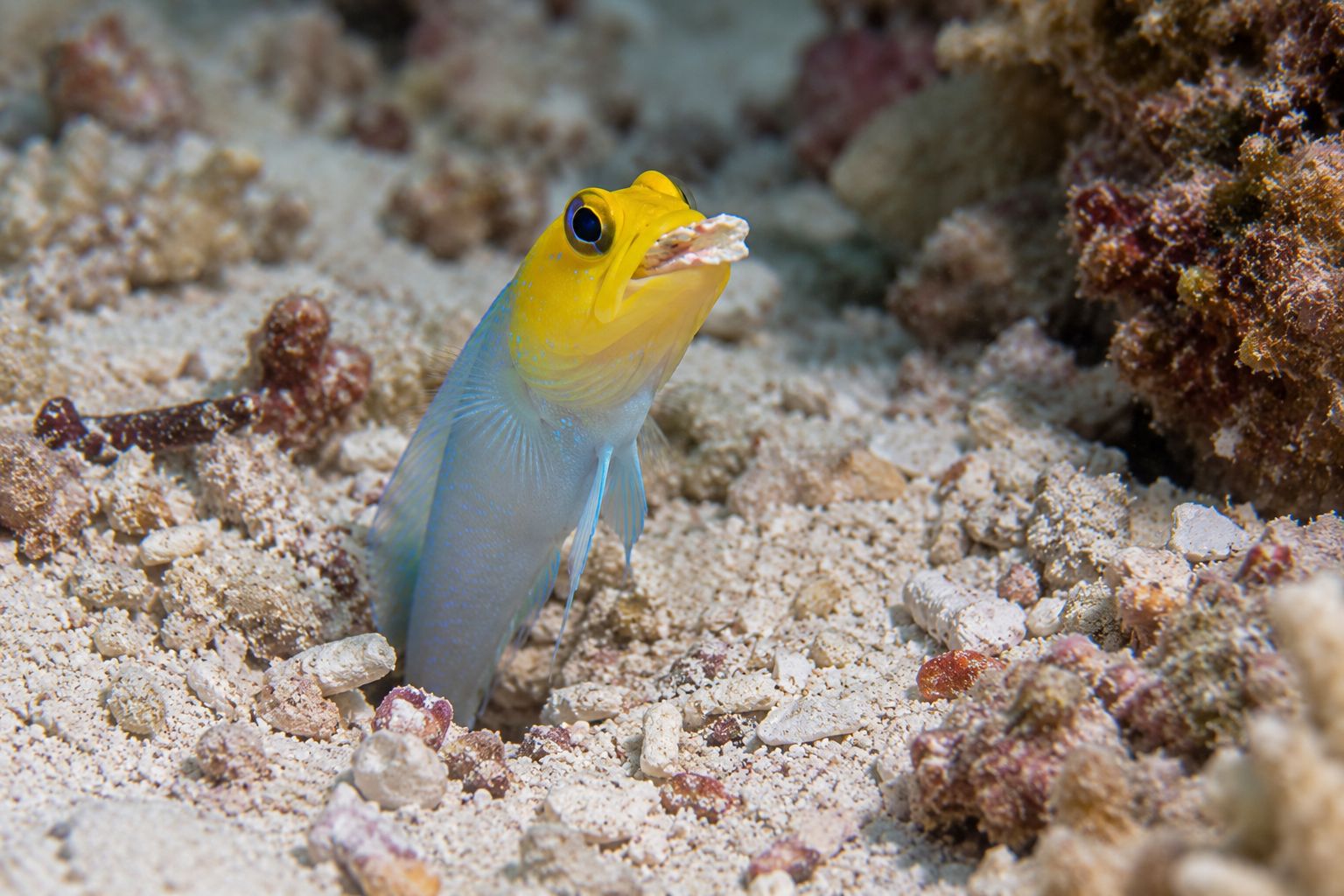
The Yellowhead Jawfish (Opistognathus aurifrons) is a small Caribbean reef fish with a bright yellow head, pale blue-white body, and a habit of peeking out from a self-built sand burrow. Native to the western Atlantic and Caribbean, this species spends much of its day hovering just above the substrate, darting out to catch food before quickly returning to cover.
Its peaceful temperament and interesting behavior make the Yellowhead Jawfish a favorite for reef aquariums. However, it needs more than just a typical sand bed. This fish depends on a protected burrow, stable rockwork, rubble material, and a tightly fitted lid. When those needs are met, a Yellowhead Jawfish can become one of the most entertaining residents in a calm saltwater community.
Yellowhead Jawfish are generally reef safe. They do not typically nip at corals, damage clam mantles, or harass most stationary invertebrates. Their attention is focused on creating and protecting a burrow, then catching tiny meaty foods that drift through the water column.
The primary reef concern is their digging. A Yellowhead Jawfish may move sand, shells, small rocks, and coral rubble as it builds and reinforces its home. Rockwork should be securely positioned before sand is added so the fish cannot undermine a loose structure. Very small shrimp or tiny crabs may also be at risk, especially if the jawfish is underfed, but most larger reef-safe invertebrates are usually left alone.
Yellowhead Jawfish are carnivores that feed on plankton, tiny crustaceans, and suspended meaty particles in the wild. In a home aquarium, they usually accept frozen mysis shrimp, enriched brine shrimp, copepods, finely chopped clam, squid, shrimp, scallop, and quality marine carnivore pellets. Feed small portions once or twice per day, ideally allowing food to drift near the entrance of the burrow. In an active community aquarium, target feeding with a turkey baster or feeding tube can help make sure the jawfish receives enough food before faster fish take it. A varied diet supports healthy color, body condition, and long-term survival.
Yellowhead Jawfish usually grow to around 4 inches long. Their small size makes them suitable for moderate-sized reef aquariums, but they still need enough open substrate to establish a secure burrow away from heavy traffic.
A 30-gallon aquarium can work for one Yellowhead Jawfish, although a 50-gallon or larger tank is often easier to maintain and provides more space for peaceful tank mates. The aquarium should include a sand bed at least 4 inches deep, along with shells and small rubble pieces that the fish can use for construction.
Yellowhead Jawfish can sometimes be kept in pairs or small groups in a larger aquarium with plenty of sand and multiple separated burrow areas. They naturally occur in colonies in the wild, but success in captivity depends on space, group size, and how the fish are introduced.
For a standard home aquarium, one Yellowhead Jawfish is the simplest and most dependable option. Aquarists attempting a group should provide a large footprint, deep substrate, and enough distance between burrow sites to reduce territorial conflicts.
With stable water conditions, regular feeding, and a low-stress environment, Yellowhead Jawfish can often live around 5 to 8 years in captivity. Their long-term health depends on a secure burrow, reliable access to food, and protection from aggressive tank mates.
A secure lid is especially important because jawfish can jump when startled. Many losses happen when a fish escapes through an opening around a return line, light fixture, or aquarium cover.
Yellowhead Jawfish are generally peaceful toward unrelated fish. They do not typically chase tank mates throughout the aquarium or cause problems for corals and larger invertebrates.
They can become defensive around their burrow if another fish repeatedly enters the same area. This is usually a territorial display rather than sustained aggression. Providing adequate sand space, calm tank mates, and several areas of visual separation helps keep the fish visible and comfortable.
Yellowhead Jawfish are usually more affordable than rarer jawfish species such as the Blue Spot Jawfish. Pricing often falls around $50 to $100, although cost can vary based on size, conditioning, shipping, and retailer availability.
When choosing one, look for a fish with clear eyes, intact fins, normal breathing, and a full body shape. A healthy Yellowhead Jawfish should be alert and responsive, even if it is hiding near the bottom of the holding tank. It is also helpful to ask whether the fish is already eating frozen foods before purchasing it.
Yellowhead Jawfish do best with peaceful community fish that will not invade their burrow, bully them during feeding, or constantly patrol the sand bed. They are typically calm outside of their immediate territory, but they may retreat and remain hidden if they feel threatened by more aggressive tank mates.
Potential tank mates include:
Avoid housing Yellowhead Jawfish with lionfish, triggerfish, large hawkfish, aggressive dottybacks, eels, puffers, large wrasses, and predatory fish. Sand-sifting gobies, jawfish species with similar territory needs, and burrowing animals may also cause problems by disturbing the jawfish’s chosen burrow area.
Yellowhead Jawfish are commonly available from online marine livestock retailers and local saltwater aquarium stores. Before buying one, make sure your tank has a secure lid, stable rockwork, a deep sand bed, and a peaceful environment suited for burrowing fish.
The Yellowhead Jawfish is an ideal choice for aquarists who enjoy reef fish with natural, observable behavior. A mature tank with soft sand, rubble, steady water quality, and gentle tank mates gives this species the comfort it needs to build a burrow, feed confidently, and become a standout part of a reef aquarium.